The honest version, from a licensed guide who rides this route four times a day.
The difficulty with Rome in one day is not the distance. It is that the best-known places are the worst
places to stand and understand them.
The short version: the walking between the famous sights is
ten minutes here, fifteen there — none of it is far. The day does not break on the walking. It breaks
on the standing, the queueing, and one hill.
Written stop by stop along the route we actually ride, with the walking times as they
are rather than as a map estimates them.
The Colosseum is a ten-minute walk. That is not the problem.
From Monti, where we start, the Colosseum is about ten minutes on foot. Nothing about that is hard.
The problem starts when you arrive. There is no quiet corner at the Colosseum and nowhere comfortable to
stand still. There are queues, there are sellers, and there are four tour groups within earshot of one another.
You can look at it. What you cannot do is stop, listen to someone explain it for a quarter of an hour, and have
any of it land.
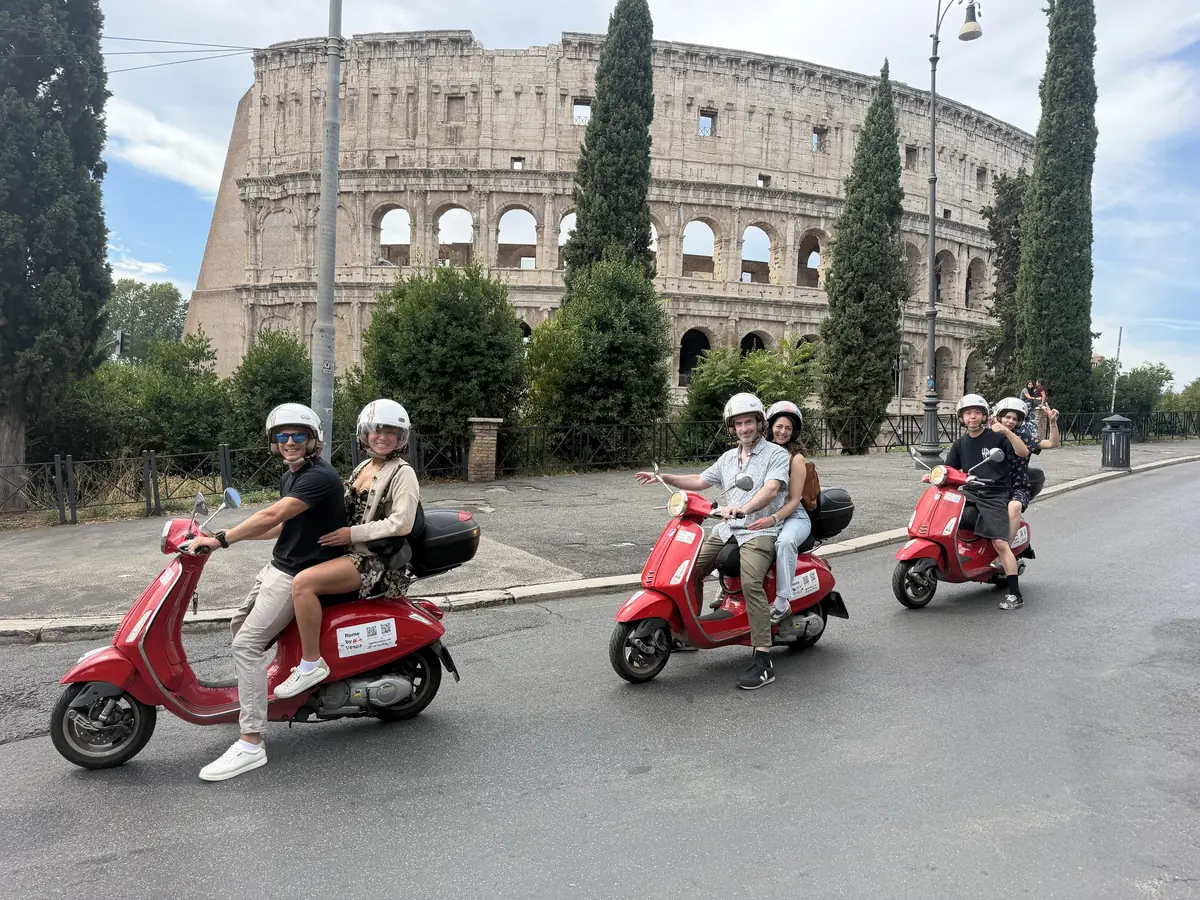
So we do not stop at the Colosseum. We stop above it, at a viewpoint where you see the amphitheatre and the
Temple of Venus and Rome in the same view — which matters, because the two only make
sense together and almost nobody is shown them that way.
And from there the story can be told in the order it happened. It begins with the fire of AD 64 and the
persecution that followed it. Nero takes the burnt ground and lays the Domus Aurea across it,
with an artificial lake at its centre and a colossal bronze statue of himself beside it — the Colossus
that would eventually lend the amphitheatre its nickname. Then Vespasian and Titus drain that lake and build,
on the private pleasure grounds of a hated emperor, something they hand back to the city. And it is still
standing in part because, centuries later, it was treated as holy ground: the place where Christian martyrs
had died.
Fifteen minutes in the right spot does more than an hour in the right queue.
We stop above it rather than in front of it. From there the amphitheatre and the Temple of Venus and Rome sit in the same view.
The Circus Maximus view is at the top of a climb
Another ten minutes from the Colosseum. Short, on paper.
But the point where the Circus Maximus becomes legible is at the top of the rise on via del Circo
Massimo. From down on the grass it is a long field. From up there you can read the shape of the track,
see the Palatine stacked above it with the imperial palaces, and the Campidoglio beyond.
That rise is the first place a one-day plan starts to slip. It is not long and it is not steep. It is simply
that you arrive warm, and warm people start looking at their watch.
The shape of the track only reads from the top of the rise. From down on the grass it is a long field.
Trastevere is the one stretch where walking wins
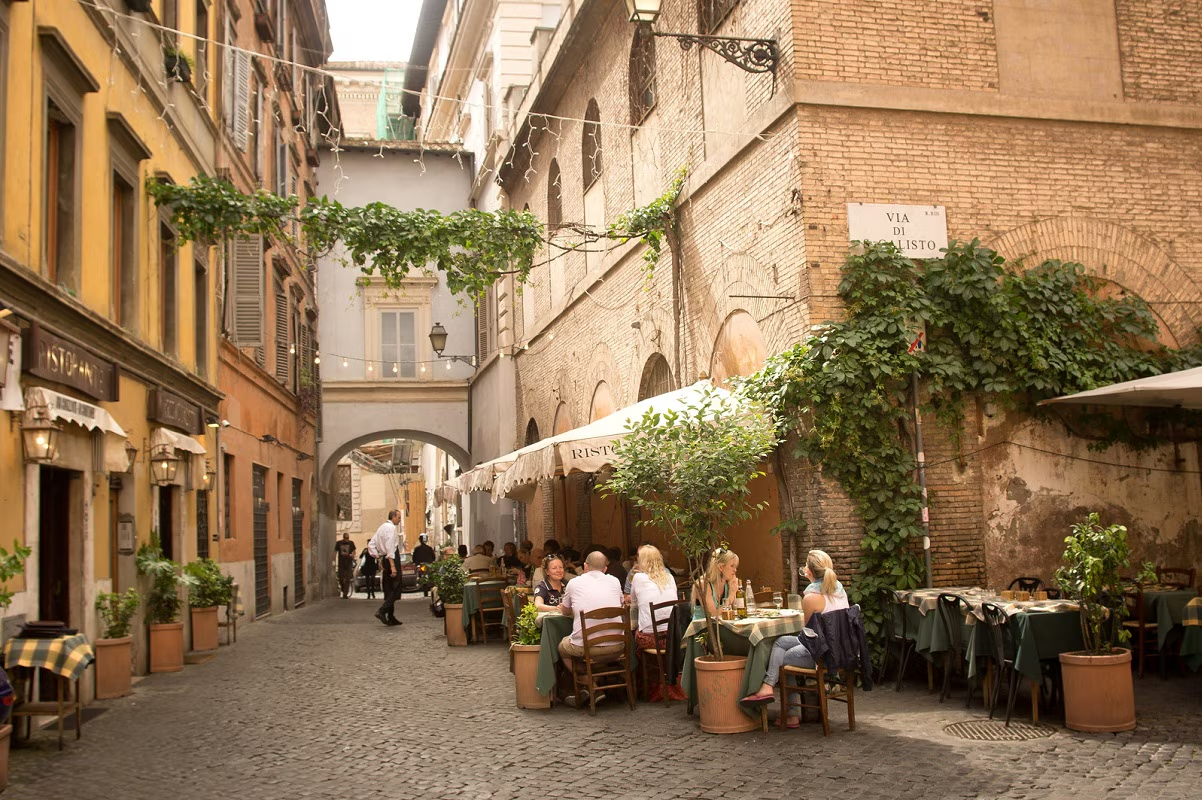
I am not going to pretend otherwise. The lanes of Trastevere are made for walking: narrow, shaded, something
worth looking at every ten metres, and no vehicle improves them. If you do one neighbourhood in Rome on foot,
do this one.
What a Vespa gives you there is a different thing, not a better one. You pass through at a pace that strings
the lanes together instead of taking them one at a time — and in Trastevere people still look up when a
Vespa goes past.
The one stretch of this route where walking is honestly the better way to do it.
Via Garibaldi is the climb that ends most one-day plans
From Trastevere up to the Janiculum is twenty to twenty-five minutes on foot, uphill the whole way.
Not dramatic. Constant.
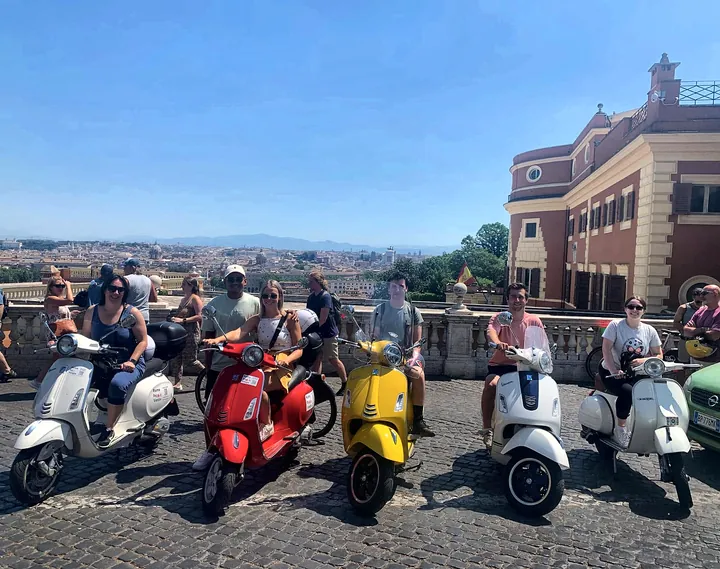
At the top is the Fontanone, and a little further the Piazzale Giuseppe Garibaldi, and from
there you see the whole of Rome at once: the domes, the roofs, the hills behind. It is the best view in the city
and it costs nothing.
This is the honest fork in any one-day plan. The Janiculum is the most rewarding stop on the whole route, and
it is also the leg that will cost you your afternoon. Most one-day itineraries you will read leave it out quietly.
They leave it out because of the hill, not because it is not worth it.
The Janiculum: the best free view in Rome, and twenty-five minutes of constant climb from Trastevere if you walk up to it.
The last four stops are close together, and that is exactly the problem
Coming down the far side on via delle Fornaci there is a point where the dome of St Peter's appears
properly — framed, not glimpsed. Then across the Ponte Principe Amedeo Savoia Aosta with
Castel Sant'Angelo ahead of you: Hadrian's mausoleum, turned fortress, turned the pope's escape route.
Castel Sant'Angelo from the bridge: Hadrian's mausoleum, turned fortress, turned the pope's escape route.
From there to Piazza Navona is about a quarter of an hour. Navona to the Trevi Fountain, then
Trevi to the Spanish Steps: short hops, the kind of distances that look like nothing on a map.
They are nothing, on fresh legs. By this point in a walking day they are not nothing. This is the stretch
where people stop asking questions — not because they have lost interest, but because they are tired,
and tired is quiet.
So can you see Rome in one day on foot?
Here is the arithmetic as it actually works.
The walking is not the problem. Ten minutes, another ten, twenty-five up the hill, fifteen
across the centre. Add it up and the moving part of the day is perfectly manageable.
The standing is the problem. Eight places, each needing ten to fifteen minutes of someone
explaining it before you leave knowing anything. Add the queues. Add the crowd you have to work around at the
famous ones. Add lunch. Add the climb.
After riding this route four times a day for years, the honest answer is this: with the same eight stops and
the same stories, on foot it is not one day. It is two, more realistically three. And by the third day people
start skipping things, which is a strange way to spend a holiday.
What I would do with one day in Rome and no Vespa
This is what I tell friends who come and do not want a tour at all.
Start before nine. The Colosseum at eight in the morning is a different building from the
Colosseum at eleven.
Choose three stops and do them properly instead of eight badly. Three things you understood
beat eight things you photographed.
Do not walk up to the Janiculum at the end of the day. Go up early, or take a taxi or a bus
and walk down. Walking up via Garibaldi on tired legs is how a good day ends badly.
Leave Trastevere for the evening and do it on foot. It is better after dark, and by then
you will not have the legs for anything more demanding.
Eat at one, not at half past two. The afternoon disappears if you let it.
Wear what you would wear to walk twelve kilometres, because you will.
None of that requires booking anything with us. It is simply what works.
And what we do instead
The same eight stops, in the same order, in two and a half hours. The engine goes off at every
one of them, which is the whole point: the Vespa is not there to be exciting, it is there to delete the walking so
that the standing still is where your time goes.
You ride your own Vespa with a guide leading, or you sit behind a licensed driver and do nothing at all. Either
way the stops are identical, and the hill up to the Janiculum stops being a decision.
You can see it. Understanding it is the part that does not fit. The eight best-known sights are close together — ten to fifteen minutes of walking between most of them — but each one needs ten to fifteen minutes of explanation before it means anything, and the queues and crowds at the famous ones eat the rest. On foot, with real stops, the same route takes two to three days.
Is Rome walkable?
Yes, and that is slightly misleading. The distances are short: Monti to the Colosseum is about ten minutes, the Colosseum to the Circus Maximus another ten, Castel Sant'Angelo to Piazza Navona about fifteen. What catches people out is the climb from Trastevere up to the Janiculum — twenty to twenty-five minutes, uphill the whole way — and the cumulative standing at eight stops.
How far apart are Rome's main sights?
On the route we ride: Monti to the Colosseum about 10 minutes on foot, the Colosseum to the Circus Maximus about 10 more, Trastevere up to the Janiculum 20 to 25 minutes of constant climb, Castel Sant'Angelo to Piazza Navona about 15 minutes. Navona to the Trevi Fountain and Trevi to the Spanish Steps are short hops. None of it is far. All of it adds up.
Is a Vespa tour better than a walking tour of Rome?
They do different jobs, and a walking tour is better at one of them. A walking tour goes deep into a small area — one neighbourhood, one site, in detail. A Vespa tour goes wide: eight landmarks across the centre in two and a half hours, including the hill most people skip. If you have three days in Rome, do both. If you have one, the Vespa covers more of it.
What is the best way to see Rome if you cannot walk far?
As a passenger. You sit behind a licensed driver, the engine goes off at each of the eight stops, and the only walking is the few steps from where we park to where we stand. It is the option we most often suggest for older travellers and for anyone with a knee that would rather not do via Garibaldi.
Do I need a licence for the Vespa tour?
Only if you want to ride your own. As a passenger you need nothing at all. To ride, a car licence covers a 125cc in Italy, plus an International Driving Permit if your licence is non-EU — and that has to be obtained at home. The details are here.
When should I start a one-day visit to Rome?
Before nine. The Colosseum at eight in the morning is a different building from the Colosseum at eleven, and the hour you gain at the start is the hour you will want back at four in the afternoon.
One day, and you want the whole route
Eight stops in two and a half hours, engine off at each one, with a licensed guide who has been
telling this story on this road since 2016. Ride your own Vespa from €135,
or sit behind a driver from €144 and walk nowhere at all.